Corrosion Monitoring for Critical Pipeline Assets
Hexitronics deployed IoT-based corrosion monitoring for pipeline infrastructure to improve asset visibility, detect early anomalies, and reduce manual inspection effort in a harsh industrial environment.
Project Snapshot
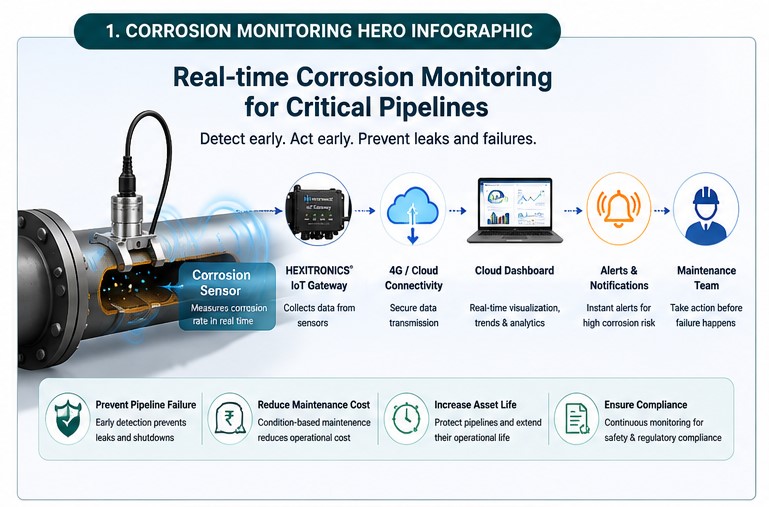
Critical pipeline infrastructure required continuous monitoring to identify corrosion-related degradation before it could affect safety, reliability, and maintenance cost. The system delivers live sensor data into a dashboard for faster review and decision-making.
Project Overview
Oil and gas pipeline assets operate under harsh environmental conditions. Corrosion, if not observed in time, can lead to unexpected maintenance, reduced asset life, and higher operational risk. The owner required a practical monitoring approach that could provide continuous insight without depending only on periodic field inspection.
Hexitronics created a connected monitoring system to capture corrosion-related data from the field, transmit it through an IoT gateway, and present it on a dashboard that could be reviewed by operations and maintenance teams.
Business Need
Reduce inspection effort while improving visibility into pipeline health and corrosion-related risk.
Technical Need
Capture meaningful field data continuously and make it available through a central dashboard for quick action.
The Challenge
Traditional corrosion checks are often manual, periodic, and reactive. That means deterioration may be discovered only after it has already started affecting the asset. The challenge was to move from occasional inspection to continuous monitoring with actionable visibility.
Manual Inspection Limits
Field visits take time, do not provide continuous records, and can miss early-stage corrosion trends.
Visibility Gap
Without live data, maintenance planning remains reactive and asset health trends are difficult to track over time.
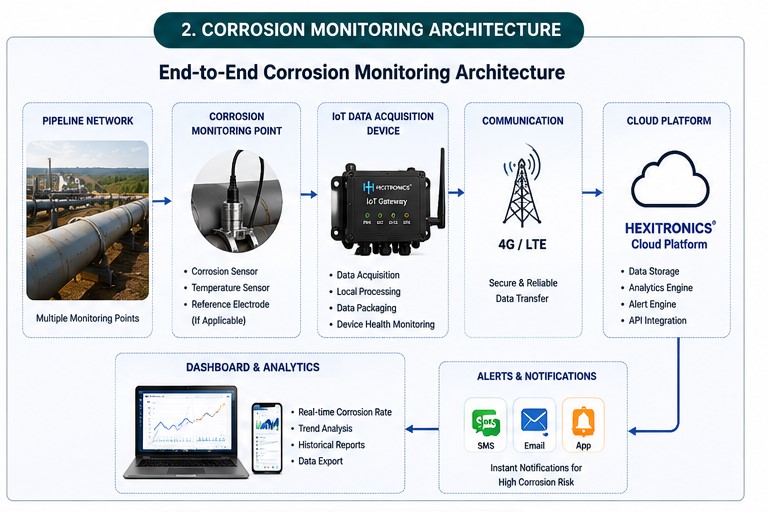
End-to-end architecture showing sensors, IoT gateway, communication network and cloud dashboard.
How We Solved It
Hexitronics deployed corrosion monitoring sensors at the pipeline network and connected them to an IoT gateway for data acquisition and transmission. The data was then visualized through a dashboard so the maintenance team could observe trends and identify early deviations.
1. Sensor Capture
Corrosion-related readings were collected from the field at regular intervals.
2. IoT Connectivity
The gateway transferred data securely for centralized monitoring and review.
3. Dashboard Analytics
Trends and alerts were made visible for faster operational response.
System Architecture
Field Sensors
Capture pipeline corrosion parameters from critical asset points.
IoT Gateway
Collects and transmits data from the field to the platform.
Cloud Dashboard
Displays trends, status, and historical records for review.
Benefits Delivered
For Operations
Improved visibility into pipeline health and better prioritization of field inspections.
For Management
Reduced manual inspection dependence and improved planning for maintenance action.
Project Summary
This corrosion monitoring deployment shows how Hexitronics helps critical infrastructure move from periodic inspection to connected, data-driven maintenance. By combining field sensors, IoT connectivity, and dashboard analytics, the system improves visibility, lowers inspection burden, and supports early anomaly detection.
It is a strong example of practical Industrial IoT for oil and gas assets.
Bring Real-Time Monitoring to Critical Assets
Similar IoT monitoring and dashboard architectures can be extended to tanks, pipelines, pumps, valves, and other high-value industrial assets.